ADAS perception, software-defined vehicles, in-vehicle edge inference, and EV charging infrastructure
17+ years building automotive AI at Renault-Nissan-Mitsubishi Alliance and through Auralink. Deputy GM, Connected Car Services, Renault-Nissan-Mitsubishi Alliance — NissanConnect deployed across 39 countries and 4M+ users, including the Google-built-in Android Automotive head unit (OpenR Link). Built Auralink: 400+ microservices and ~20 AI agents for EV charging orchestration, BESS coordination, and grid balancing (arXiv preprint 2603.08736). Vectis AI adds OBD-II and ESP32 vehicle edge inference. We work to ISO 26262, ISO 21448 SOTIF, UNECE R155 cybersecurity, UNECE R156 OTA, and AUTOSAR.
The founder shipped automotive AI at OEM scale during 17+ years at Renault-Nissan-Mitsubishi Alliance — not as an advisor from the side, but as the architect writing the system documents and reviewing pull requests. Hyperion's Advise/Build/Train engagement brings that same operating discipline to your programme: ADAS perception redesign for ASIL decomposition, ECU edge inference optimisation under AUTOSAR, in-vehicle copilot architecture under R155, and EV charging network orchestration. We bring ISO 26262, ISO 21448 SOTIF, and UNECE R155/R156 discipline from day one — not as a late-stage compliance add-on.
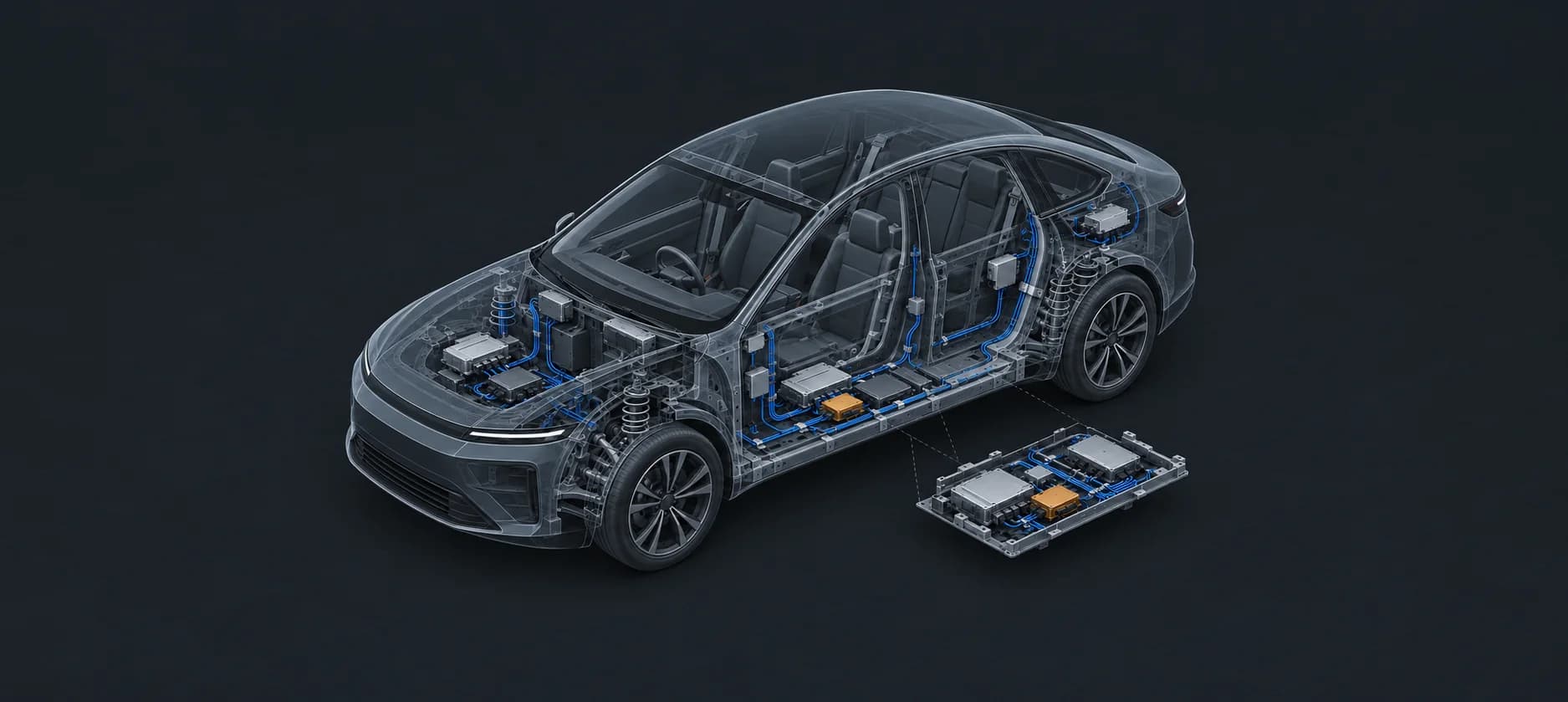
AI plays a different role at each level of vehicle capability. We engineer for the category you are actually building.
Connectivity, telemetry, remote services and cloud integration.
Central compute, decoupled software, service-oriented architecture, OTA and lifecycle.
Contextual AI, multimodal assistants, prediction and on-device intelligence.
Perception, localisation, planning, control, validation and runtime safety.
Connected-vehicle work draws on the founder's Renault–Nissan–Mitsubishi Alliance experience (Deputy GM, Connected Car Services). Hyperion supports architecture, engineering and production-readiness — not autonomous-driving programme ownership.
Based on common industry needs
Four weeks to a strategy document, a business case, an ROI model, and a 12-month execution plan — scoped for industrial operators where OEE, safety-regime timelines, and physical-system procurement cycles are the real constraints, not just board optics
Twelve weeks to harden an edge or embedded AI pilot stuck before production — on constrained hardware, inside safety envelopes, under latency and reliability requirements the pilot was never designed to meet
Twelve weeks to a production-grade multi-agent system that serves as the software and control-plane complement to your cyber-physical stack — fleet intelligence, SCADA-adjacent orchestration, or autonomous operations — with the eval harness, the observability stack, and the SRE handoff your team needs to operate it
Twelve to twenty-four weeks to risk-classify your AI systems, complete the conformity assessment, produce the Annex IV technical documentation, and stand up post-market monitoring — with special depth on Annex III high-risk categories for autonomous, industrial, and robotics deployments
The Full-Stack Physical AI layers most relevant to this sector.
A 30-minute call is enough to diagnose whether your AI initiative is stuck for industry-specific reasons — and what to do about it.