Skip to content

Physical AI practice

Turn a technically promising system into a dependable product.

Product leadership for robots, autonomous systems and intelligent machines and equipment: what customers buy, what the system must do in real conditions, what it costs across its life, and who owns it after launch.

Where this work starts

  • The prototype works. The product and the business case are unclear.

    What customers buy, at what price and with what obligations is still open.

  • A pilot succeeded once and cannot yet be repeated.

    Nobody can state what has to be true for the next sites to go the same way.

  • Hardware, software, AI and field teams decide separately.

    Each decision is defensible on its own. Together they no longer describe one product.

  • A launch, investment or stop decision is due.

    The date is fixed. The evidence behind go, redirect, sequence or stop is not yet assembled.

What changes

  • One accountable product owner across customer value, economics, hardware, software, AI, safety and field operations.
  • Decisions recorded with the evidence behind them, so they stop being reopened.
  • Evaluation in representative conditions before a commitment, not after it.
  • A lifecycle view: installation, support, updates, recovery and cost to serve.
  • A handover that leaves your team running the product and responsible for it.
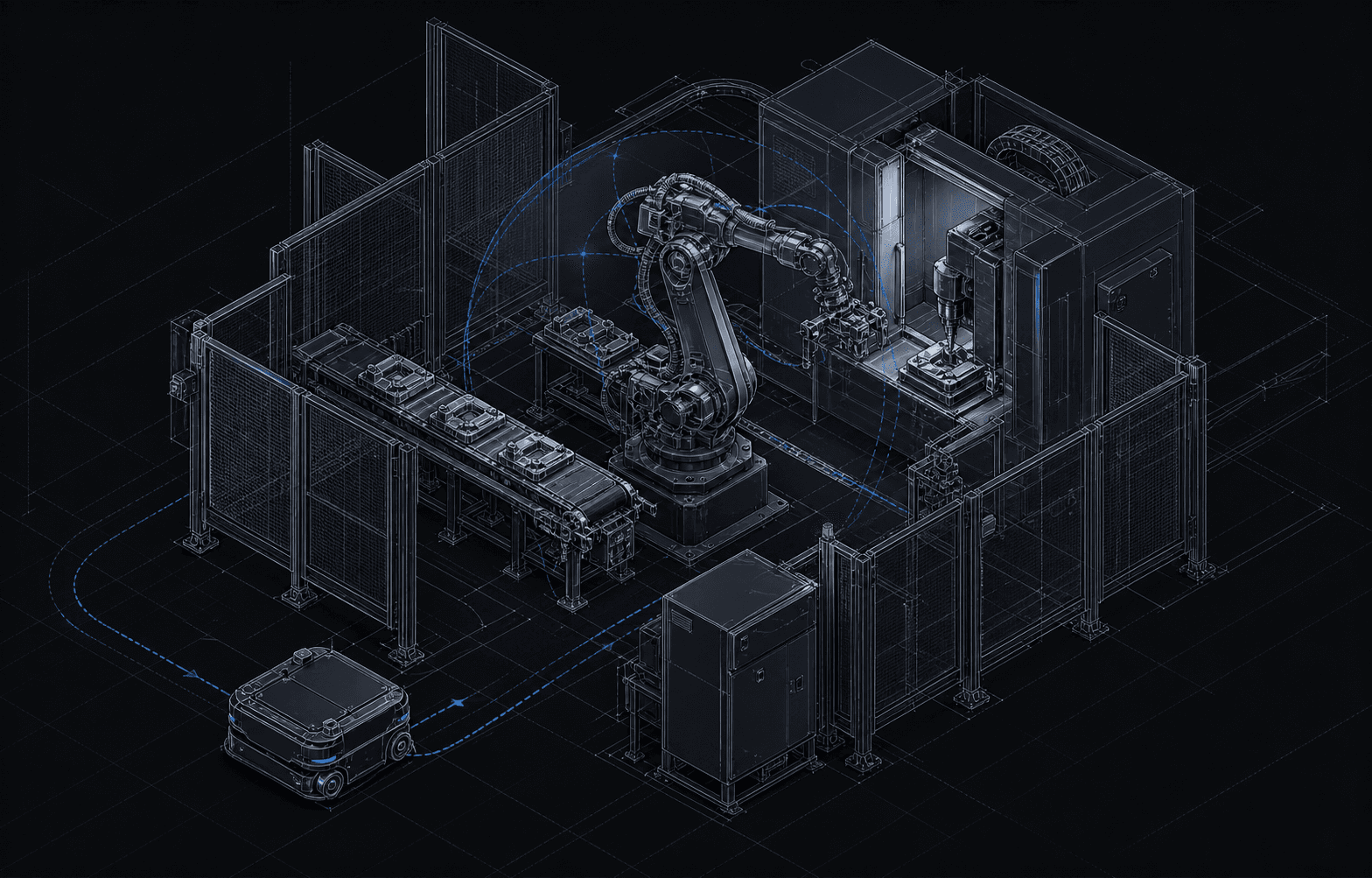
Illustrative CAD view of a guarded robot cell, machine tooling, conveyor and mobile material platform.
Illustrative system view · not a client deployment

How the work runs

  1. Frame

    A 30-minute fit call identifies the decision or result, the missing evidence and whether this is the right mandate. Sometimes the answer is that it is not.

  2. Scope

    Scope, acceptance evidence, responsibilities and price are agreed in writing before work starts.

  3. Work

    Work runs against named evidence gates from the Hyperion Physical AI Product System, with your team and any specialists named in scope.

  4. Hand over

    Every engagement ends with a decision record, the evidence behind it and a named owner on your side. Rights in documents and any software Hyperion supplies follow the Terms of Sale; where a deliverable is to go into a product or service you supply to others, the wider rights are set out in the proposal.

Experience, research and methods

Explore the founder's background, Hyperion's research and the methods behind the work.

Scoping examples

Each example shows how an assignment can be scoped. None describes client work, and none carries a result or a price.

  • AI: optional

    Connected-service product delivery and commercialisation

    Model-enabled features only where a defined user task benefits. Existing platform functionality is compared first.

    Who asks
    Connected-services or digital-product leader
    Situation
    A customer-facing connected service spans vehicle, cloud and app teams, and its value, adoption, support and release ownership are not yet settled.
    What is bought
    One agreed customer and product milestone: a customer-grounded offer, evaluated service behaviour, and a delivery and support model with a commercial validation point.
    Boundary
    No driver-assistance, automated-driving or homologation authority. Subscriptions and paid feature gates are options to test, not defaults.
  • AI: optional

    Charger or energy-platform product development

    Optional. Bounded diagnostics or orchestration only where they beat the existing approach.

    Who asks
    Product leader at a charging-equipment maker or charging-software company
    Situation
    Hardware, firmware, back-end and service work do not yet add up to one customer product with a release approach, and mixed asset versions make a nominally compatible feature unreliable in the field.
    What is bought
    One product-development and commercial milestone: the reusable software core and the validated hardware configurations it runs on, interoperability and field-release evidence for the agreed variants, and named support responsibilities.
    Boundary
    Electrical protection, local control and grid limits are not replaced by software. No protocol compatibility or certification is claimed from application tests. Engineering responsibility is named in scope.
  • AI: optional

    Mobile-robot or yard-automation product and deployment

    Learned perception or planning is evaluated separately from deterministic infrastructure and compared with conventional automation and workflow redesign.

    Who asks
    Product leader at a robotics vendor, or the automation sponsor at a site
    Situation
    A mobile-robot or yard-automation prototype works at one site. The product, the integration effort and the operating responsibilities for the next sites are not defined.
    What is bought
    One development or site milestone with mission evidence in representative conditions, a defined integration scope and lifecycle ownership.
    Boundary
    No standalone safety certification and no universal autonomy claim. Robotics, site and safety contributors are named in scope.