コンテンツへスキップ
すべての業界

モビリティ、エネルギー、建物、公共空間運用、レジリエントな都市サービスを対象とするシステム・オブ・システムズの隣接セクター

隣接セクター

スマートインフラ・都市システム

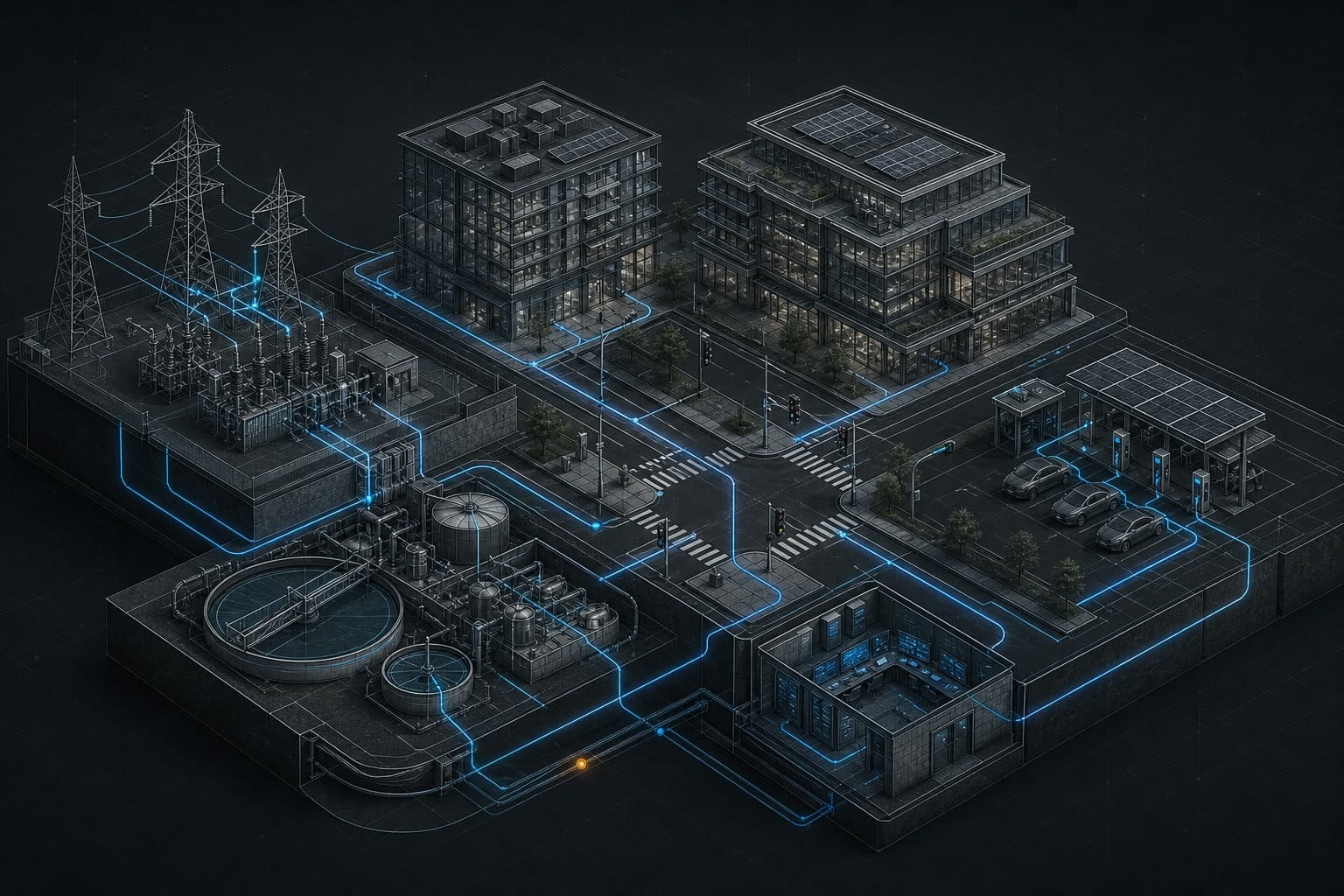
Mobility, energy, buildings and public-space pilots work inside their own silos, but no accountable owner can show that their interfaces, data rights, emergency modes, procurement boundaries and lifecycle economics form one operable urban system.

レビュー済みの意思決定資料は現在英語で提供しています。この翻訳タイトルはナビゲーション用です。ネイティブレビューまではローカル検索送信の対象外です。

このプロダクト判断を相談する
01

初期の任務文脈

Urban mobility

Transit, traffic, kerb, parking, charging and active mobility coordinated without erasing operator boundaries.

Energy & buildings

Grid constraints, distributed energy, charging, building controls and demand response treated as one operating context.

Public-space operations

Lighting, waste, maintenance, environmental sensing and field work designed around accountable service operations.

Emergency & resilience

Peak demand, disruption, evacuation, incident command and degraded modes with explicit human authority.

Urban data & interoperability

Identity, provenance, access, semantics, consent, retention and open interfaces across public and private operators.

Procurement & asset lifecycle

Modular acquisition, integration ownership, service levels, supplier exit, renewal and stranded-asset risk.

02

物理システムの境界

スマートインフラ・都市システムの物理システム境界The product is not a city dashboard or a catalogue of AI use cases. It is a governed system of systems: each operator retains domain authority while shared interfaces, data contracts, emergency modes, cyber boundaries and whole-life economics are owned across the urban lifecycle.PHYSICAL + RUNTIME SYSTEMプロダクト境界HUMAN + OPERATING SYSTEM01Urban outcome

Mobility, energy, buildings and public space

02Sense

Assets, environment, demand and incidents

03Exchange

Identity, provenance and interoperable data contracts

04Decide

Bounded optimisation and operator decision support

05Domain control

Transport, grid, building and public-space systems

06Human authority

Operators, emergency services and public accountability

07Coordinate

Cross-domain service, procurement and recovery

08Lifecycle

Reliability, renewal, vendor exit and whole-life value

  1. 01Urban outcomeMobility, energy, buildings and public space
  2. 02SenseAssets, environment, demand and incidents
  3. 03ExchangeIdentity, provenance and interoperable data contracts
  4. 04DecideBounded optimisation and operator decision support
  5. 05Domain controlTransport, grid, building and public-space systems
  6. 06Human authorityOperators, emergency services and public accountability
  7. 07CoordinateCross-domain service, procurement and recovery
  8. 08LifecycleReliability, renewal, vendor exit and whole-life value
The product is not a city dashboard or a catalogue of AI use cases. It is a governed system of systems: each operator retains domain authority while shared interfaces, data contracts, emergency modes, cyber boundaries and whole-life economics are owned across the urban lifecycle.
03

プロダクトオーナーシップが分断される場所

  1. Mobility, energy, building and public-space operators optimise separate KPIs while cross-domain outcomes have no accountable product owner.
  2. Public and private data cross organisational boundaries without stable identity, provenance, access, retention or reuse contracts.
  3. Emergency precedence, degraded operation and manual authority are assumed rather than encoded across system interfaces.
  4. Procurement divides the system into vendor packages while integration, interoperability, change control and exit remain unowned.
  5. Cyber and safety analysis stops at each subsystem even though consequential failure can propagate through shared dependencies.
  6. Maintenance, connectivity, energy, staffing, supplier lock-in, accessibility and obsolescence sit outside the initial innovation case.
04

6つのプロダクト判断

顧客・作業者価値

Which shared urban outcome improves without weakening another operator's mission?

ゲート: The outcome, affected communities, accountable sponsor and unacceptable trade-offs are explicit.

エビデンス

Which normal, peak, degraded and emergency conditions must the system-of-systems evidence represent?

ゲート: The evaluation plan covers domain interactions, human workload, distributional effects and recovery.

システム・技術

Which decisions remain inside each subsystem and which require shared coordination?

ゲート: Interfaces, timing, data, authority, fallback and interoperability obligations have named owners.

安全・責任

Who has authority when cyber events, sensing, connectivity or context degrades?

ゲート: Independent safeguards, emergency precedence, human intervention and safe recovery are reviewable.

運用・ライフサイクル

Can multiple operators procure, operate, change and exit the system without losing accountability?

ゲート: Service ownership, procurement boundaries, incident command, change control and vendor exit are packaged.

プロダクト経済性

Does public value survive integration, resilience, staffing and asset-lifecycle cost?

ゲート: Whole-life economics include interfaces, operations, failures, renewal, accessibility and stranded-asset risk.

05

作業者・プロダクト経済性

Cross-domain outcome
Value is measured across the urban service, not as an isolated subsystem efficiency gain.
Coordination burden
Integration, shared operations, data stewardship and incident command are recurring product costs.
Resilience value
Peak demand, emergency operation, degraded modes and recovery belong in the investment case.
Whole-life economics
Procurement, maintenance, connectivity, energy, renewal, vendor exit and obsolescence are modelled together.
06

提供する意思決定成果物

System-of-systems boundary map

Outcomes, operators, physical assets, shared dependencies, product seams and accountable ownership.

Authority & degraded-mode matrix

Normal, peak, cyber, emergency and recovery authority across automated and human decisions.

Interoperability & data contract

Interfaces, semantics, identity, provenance, access, retention, service levels and exit requirements.

Evidence, safety & cyber plan

Scenario library, distributional effects, failure injection, safeguards, incident learning and acceptance gates.

Procurement architecture

Modular lots, integration accountability, vendor obligations, change control, portability and transition rights.

Whole-life decision model

Public value, operations, resilience, staffing, maintenance, energy, renewal and obsolescence economics.

07

エビデンス資料

  • エビデンス境界Publication scope

    This dossier is Hyperion-authored systems analysis for a bounded research context. It is a decision model, not evidence of a completed municipal or smart-infrastructure engagement.

  • 創業者の職務経験Adjacent product context

    Founder-career work spans connected mobility and EV-charging product contexts. That experience informs interface questions; it does not establish city-wide delivery authority.

  • Hyperion の研究Distributed coordination hypothesis

    Auralink is a Hyperion-authored research reference used to inspect distributed energy and coordination patterns. It is not field, customer or commercial evidence.

  • エビデンス境界Assurance boundary

    Public law, procurement, safety, cybersecurity, accessibility, fundamental-rights and domain conclusions require the accountable authorities and qualified specialists for the specific programme.

検証すべき制約 — 資格ではありませんPublic procurement and concession rulesCybersecurity and critical-entity obligationsInteroperability and open interfacesData protection and AI regulationSafety, accessibility and fundamental rights

Hyperionが主張しないこと

Hyperion does not claim municipal client delivery, concession or procurement authority, emergency-operations authority, critical-infrastructure certification, public-safety assurance, or endorsement by a city or public body. Programme-specific legal, procurement, safety, cybersecurity and fundamental-rights review remains with the accountable organisations and qualified specialists.

08

率直な適合性・責任ある利用境界

適合すると考えられる条件

  • One consequential decision crosses multiple urban operators, physical systems and procurement boundaries.
  • An accountable sponsor can convene operations, architecture, procurement, safety, cyber, legal and community perspectives.
  • The initial scope is civil, bounded and explicit about affected people, public value and unacceptable outcomes.
  • The programme wants an evidence-gated product decision and is prepared to simplify, redirect, pause or stop.

適合しない条件

  • The request is a generic smart-city use-case catalogue, innovation theatre or technology-vendor selection without a product decision.
  • The scope asks Hyperion to replace public authority, legal advice, procurement accountability, certification or domain assurance.
  • The intended system depends on mass surveillance, social scoring, coercive biometrics or discriminatory access to services.
  • Automated optimisation would directly control consequential infrastructure without bounded authority and accountable human intervention.

譲れない境界

  • No mass surveillance, social scoring or coercive biometric identification.
  • No discriminatory allocation of mobility, energy, public space or essential services.
  • No language model directly controls safety-critical urban infrastructure.
  • No removal of accountable operator authority in consequential or emergency decisions.
  • No programme proceeds without context-specific legality, accessibility, safety, cybersecurity and public-interest review.

Any engagement requires programme-specific review by the accountable public and private operators and qualified legal, procurement, safety, cybersecurity, accessibility and domain specialists. Hyperion does not provide legal advice, conformity assessment, certification or public authority.

適切な支援形態

Product Decision Review

Best fit for one consequential system-of-systems decision: product boundary, operator authority, interoperability and data contract, degraded operation, procurement architecture, evidence plan or whole-life proceed / redirect / stop recommendation.

このプロダクト判断を相談する